

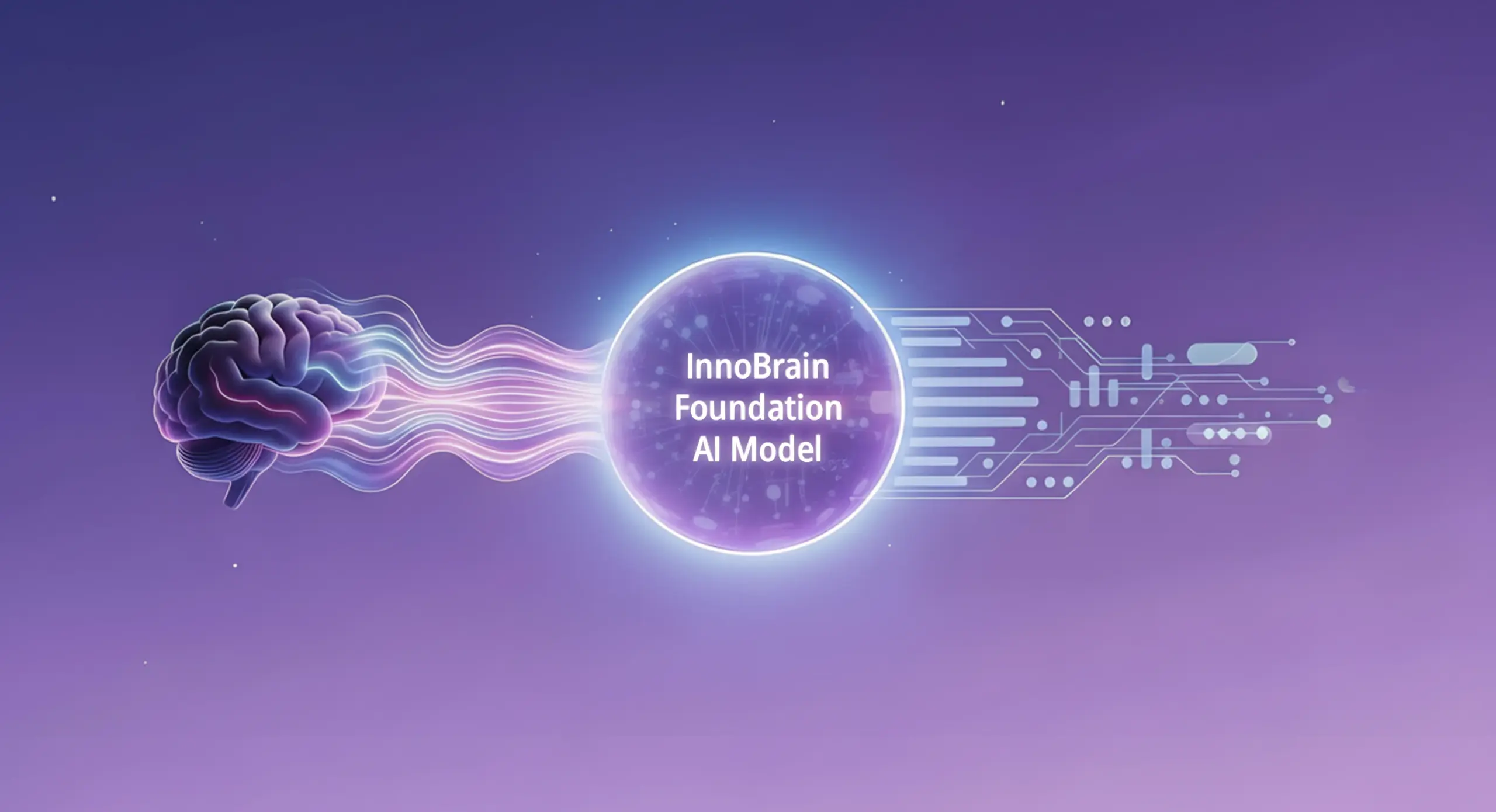
InnoBrain’s Foundation AI model translates raw brain activity (EEG signals) into clear, actionable metrics and insights about how we think, feel, and perform. Each metric captures a distinct aspect of cognition and emotion, enabling organizations to enhance safety, performance, and well-being. Below are the core cognitive features of InnoBrain’s Foundation AI model, integrated into its Human Cognitive Monitoring platform.
Mental Workload
Definition: Mental workload refers to the cognitive resources required by a task relative to an individual’s capacity, influenced by task complexity, time pressure, and the presence of multitasking. Moderate workload enhances performance, but excessive demand impairs accuracy and increases error risk [1, 2].
Interpreting Your Results: Scores range from 0 (minimal workload: task feels effortless or understimulating) to 1 (maximal workload: overwhelming cognitive demand, risking errors or burnout).
Brain Regions Involved: This metric is based on brain activity in cortical areas includingthe frontal lobe (executive functions and working memory), parietal lobe (attention and integration), and occipital lobe (visual processing in relevant tasks). Depending on the number of available electrodes to cover the respective regions, different intensities and accuracy are expected [3, 4, 5, 6, 7, 8, 9].
Potential Application Areas:
Operational safety & risk : Real-time overload detection for safety-critical roles (air traffic control, control rooms, remote operations) to trigger interventions before errors occur.
Training & performance : Adaptive training that scales scenario complexity and pacing based on trainee capacity (simulators, onboarding, certification).
Design & product validation : Workload-driven HMI/UX optimization (reduce cognitive friction, improve readability, streamline flows) and comparison of interface variants.
Work planning & productivity : Staffing and task allocation based on workload trends to prevent overload accumulation and sustain performance.
Fatigue
Definition: Fatigue is a state of reduced alertness and cognitive capacity due to prolonged activity or sleep deprivation, manifesting as slowed responses and impaired judgment [24].
Interpreting Your Results: Scores range from 0 (minimal fatigue: full alertness) to 1 (maximal fatigue: severe exhaustion, impacting safety). Early detection prevents escalation.
Brain Regions Involved: This metric detects changes in the parietal lobe (spatial attention and integration), the occipital lobe (visual processing slowdowns), and the central lobe, which increases activity here, signaling exhaustion. [25, 26].
Potential Application Areas:
Safety-critical operations : Early fatigue detection for drivers, pilots, remote operators, and industrial control roles to prevent lapses, slowed reaction, and judgment errors.
Shift and rostering optimization : Fatigue-informed scheduling in hospitals, logistics, and manufacturing (identify high-risk windows, redesign shifts, improve recovery).
Field operations & heavy industry : Real-time fatigue risk management in mining, construction, and maintenance tasks where incident cost is high.
Readiness and endurance management : Monitoring cumulative fatigue in defense, emergency services, and expeditionary settings to support mission planning and recovery cycles.
Calmness
Definition: Calmness is a state of emotional equilibrium and reduced arousal, characterized by low agitation and effective emotion regulation, often linked to mindfulness practices.
Interpreting Your Results: Scores range from 0 (minimal calmness: high agitation) to 1 (maximal calmness: profound relaxation and stability). Higher scores correlate with better emotional resilience.
Brain Regions Involved: This metric is based on brain activity in the frontal lobe (emotion regulation via prefrontal areas) and occipital lobe (alpha wave increases during relaxation), with indirect links to subcortical structures like the amygdala (emotional processing) [16, 17, 18, 19].
Potential Application Areas:
Well-being & prevention : Continuous monitoring of emotional equilibrium to support burnout prevention programs and recovery planning in knowledge work and high-stress occupations.
Biofeedback & self-regulation : Closed-loop coaching for relaxation techniques (breathing, mindfulness, HRV/EEG biofeedback) with progress tracking over time.
Performance under pressure : Readiness assessment for roles requiring composure (pilots, operators, elite sports, public speaking), including pre-task stabilization routines.
Clinical and therapeutic support (non-diagnostic) : Objective complement to stress-management interventions (tracking response to therapy routines, adherence, and improvement trends).
Situational Awareness
Definition: Situational awareness (SA) is the perception of environmental elements, comprehension of their meaning, and projection of future states, crucial for decision-making in dynamic settings [10].
Interpreting Your Results: Scores range from 0 (minimal SA: disorientation or ignorance of key cues, heightening risks) to 1 (maximal SA: full environmental grasp and accurate forecasting). Low scores signal immediate intervention needs.
Brain Regions Involved: This metric is based on brain activity in the parietal lobe (spatial attention and integration), occipital lobe (visual cues), and the frontal lobe (planning and projection). Depending on the number of available electrodes to cover the respective regions, different intensities and accuracy are expected [11, 12, 13, 14, 15].
Potential Application Areas:
Operational safety & risk : Early identification of awareness lapses in dynamic environments (air traffic, rail operations, maritime bridges, surveillance) to reduce incident likelihood.
Human–automation interaction : Validation of handovers and “mode awareness” in automated systems (autonomous driving, remote supervision) to detect when operators are out-of-the-loop.
Training & debriefing : Objective feedback on perception–comprehension–projection during scenarios; supports coaching, after-action review, and proficiency benchmarking.
Decision support : Context-aware prompts (checklists, cues) when SA indicators drop during peak complexity.
Concentration
Definition: Concentration is focus on a task, filtering distractions to enhance performance, involving executive control and sensory gating [20].
Interpreting Your Results: Scores range from 0 (minimal concentration: high distractibility) to 1 (maximal concentration: deep, uninterrupted focus). Environmental factors can influence readings.
Brain Regions Involved: This metric is based on brain activity in the parietal lobe (attention direction) and central region (attention regulation) [21, 22, 23].
Potential Application Areas:
Learning & assessment : Monitoring sustained attention during studying, exams, and digital learning to detect distraction periods and optimize study plans.
High-precision performance : Support for tasks requiring prolonged focus (quality inspection, programming, trading, surgery support roles, marksmanship/archery training).
HMI/UX & environment design : Evidence-based evaluation of interface layouts, notification strategies, and workspace conditions (noise, interruptions, screen density).
Attention challenges research : Objective measurement in research contexts (e.g., ADHD-related studies, cognitive ergonomics), enabling within-subject comparisons over time.
Stress
Definition: Stress is the physiological and psychological response to perceived threats or demands, activating adaptive mechanisms but potentially leading to chronic issues if prolonged [27].
Interpreting Your Results: Scores range from 0 (minimal stress: relaxed state) to 1 (maximal stress: intense distress or anxiety).
Brain Regions Involved: This metric captures the frontal lobe (regulation via prefrontal) and the parietal lobe. The latter is especially important as it plays a key role in integrating sensory information and spatial awareness, which can be significantly impacted by cognitive stress [28, 29, 30].
Potential Application Areas:
Operational resilience : Real-time stress escalation detection in high-stakes environments (first responders, mission control, security operations) to trigger support protocols.
Training & stress inoculation : Quantifying stress responses during drills and simulations to personalize exposure, measure adaptation, and validate training effectiveness.
Workplace well-being : Team-level insights (aggregated) to identify chronic stress drivers, evaluate interventions, and reduce attrition risk.
Product and process evaluation : Measuring stress impact of workflows, tools, and system changes (e.g., new UI rollout, SOP changes) before scaling organization-wide.
Motion Sickness
Definition: A set of uncomfortable symptoms—like nausea, dizziness, or drowsiness—caused by the brain getting conflicting signals from the senses (usually the eyes seeing a stable environment, while the inner ear senses motion, or vice versa).
Interpreting Your Results: Scores range from 0 (minimal symptoms: no discomfort) to 1 (maximal symptoms: severe nausea or vomiting). Triggers vary by individual.
Brain Regions Involved: This metric is based on brain activity in the occipital lobe (visual processing), parietal lobe (sensory integration), and frontal lobe (emotional responses) [31, 32, 33, 34].
Potential Application Areas:
Automotive & mobility design : Evaluation of in-cabin experiences and AV passenger scenarios (visual–vestibular conflict mitigation, seating/UX strategies, display behavior).
VR/AR & simulation : Identifying sickness-inducing content and optimizing frame rate, motion design, locomotion, and camera behaviors in training and gaming.
Training readiness & selection : Screening and adaptation strategies for simulator-based training (aviation, driving, defense) to reduce dropout and improve tolerance.
Product and intervention testing : Objective measurement for evaluating countermeasures (content changes, habituation protocols, environmental adjustments).
References
- Osia, A., Tahamtan, Z., Zhao, L., Davari, M., & Nybacka, M. (2025). A Real-time Unconstrained EEG-Classifier for Mental Workload Monitoring. Presented at the DSC 2025 Europe – Driving Simulation Conference Europe 2025, Sep 24-26 2025, Stuttgart, Germany.
- Eggemeier, F. T., Wilson, G. F., Kramer, A. F., & Damos, D. L. (1991). Workload assessment in multi-task environments. In Multiple task performance (pp. 207-216). CRC Press
- Gevins, A., Smith, M. E., Leong, H., McEvoy, L., Whitfield, S., Du, R., & Rush, G. (1998). Monitoring working memory load during computer-based tasks with EEG pattern recognition methods. Human factors, 40(1), 79-91.
- Klimesch, W. (1999). EEG alpha and theta oscillations reflect cognitive and memory performance: a review and analysis. Brain research reviews, 29(2-3), 169-195.
- Miller, E. K., & Cohen, J. D. (2001). An integrative theory of prefrontal cortex function. Annual review of neuroscience, 24(1), 167-202.
- Corbetta, M., & Shulman, G. L. (2002). Control of goal-directed and stimulus-driven attention in the brain. Nature Reviews Neuroscience, 3(3), 201–215.
- Bastiaansen, M. C., Posthuma, D., Groot, P. F., & De Geus, E. J. (2002). Event-related alpha and theta responses in a visuo-spatial working memory task. Clinical neurophysiology, 113(12), 1882-1893.
- Li, W., Cheng, S., Dai, J., & Chang, Y. (2025). Effects of Mental Workload Manipulation on Electroencephalography Spectrum Oscillation and Microstates in Multitasking Environments. Brain and Behavior, 15(1), e70216.
- Mental workload assessment by monitoring brain, heart, and eye with six biomedical modalities during six cognitive tasks
- Endsley, M. R. (2017). Toward a theory of situation awareness in dynamic systems. In Situational awareness (pp. 9-42). Routledge
- Dong, W., Fang, W., Qiu, H., & Bao, H. (2024). Impact of situation awareness variations on multimodal physiological responses in high-speed train driving. Brain Sciences, 14(11), 1156.
- Di Flumeri, G., De Crescenzio, F., Berberian, B., Ohneiser, O., Kramer, J., Aricò, P., … & Piastra, S. (2019). Brain–computer interface-based adaptive automation to prevent out-of-the-loop
- Catherwood, D., Edgar, G. K., Nikolla, D., Alford, C., Brookes, D., Baker, S., & White, S. (2014). Mapping brain activity during loss of situation awareness: an EEG investigation of a basis for top-down influence on perception. Human factors, 56(8), 1428-1452.
- Chen, J., Chen, A., Jiang, B., & Zhang, X. (2024). Physiological records-based situation awareness evaluation under aviation context: A comparative analysis. Heliyon, 10(5).
- Kästle, J. L., Anvari, B., Krol, J., & Wurdemann, H. A. (2021). Correlation between Situational Awareness and EEG signals. Neurocomputing, 432, 70-79.
- Jacobs, G. D., Benson, H., & Friedman, R. (1996). Topographic EEG mapping of the relaxation response. Biofeedback and self-regulation, 21(2), 121-129.
- Lee, D. J., Kulubya, E., Goldin, P., Goodarzi, A., & Girgis, F. (2018). Review of the neural oscillations underlying meditation. Frontiers in neuroscience, 12, 178.
- Ochsner, K. N., & Gross, J. J. (2005). The cognitive control of emotion. Trends in cognitive sciences, 9(5), 242-249.
- Krishna, D., Singh, D., & NK, M. (2025). Determining the depth of meditation through frontal alpha asymmetry. Frontiers in Human Neuroscience, 19, 1576642.
- Sohlberg, M. M., & Mateer, C. A. (1987). Effectiveness of an attention-training program. Journal of clinical and experimental neuropsychology, 9(2), 117-130.
- Foxe, J. J., & Snyder, A. C. (2011). The role of alpha-band brain oscillations as a sensory suppression mechanism during selective attention. Frontiers in psychology, 2, 154.
- Corbetta, M., & Shulman, G. L. (2002). Control of goal-directed and stimulus-driven attention in the brain. Nature reviews neuroscience, 3(3), 201-215.
- Sanchis, J., García-Ponsoda, S., Teruel, M. A., Trujillo, J., & Song, I. Y. (2024). A novel approach to identify the brain regions that best classify ADHD by means of EEG and deep learning. Heliyon, 10(4).
- Aaronson, L. S., Teel, C. S., Cassmeyer, V., Neuberger, G. B., Pallikkathayil, L., Pierce, J., … & Wingate, A. (1999). Defining and measuring fatigue. Image: the journal of nursing scholarship, 31(1), 45-50.
- Torsvall, L. (1987). Sleepiness on the job: continuously measured EEG changes in train drivers. Electroencephalography and clinical Neurophysiology, 66(6), 502-511.
- Qin, Y., Hu, Z., Chen, Y., Liu, J., Jiang, L., Che, Y., & Han, C. (2022). Directed brain network analysis for fatigue driving based on EEG source signals. Entropy, 24(8), 1093.
- https://www.who.int/news-room/questions-and-answers/item/stress
- Katmah, R., Al-Shargie, F., Tariq, U., Babiloni, F., Al-Mughairbi, F., & Al-Nashash, H. (2021). A review on mental stress assessment methods using EEG signals. Sensors, 21(15), 5043.
- Vanhollebeke, G., De Smet, S., De Raedt, R., Baeken, C., van Mierlo, P., & Vanderhasselt, M. A. (2022). The neural correlates of psychosocial stress: A systematic review and meta-analysis of spectral analysis EEG studies. Neurobiology of stress, 18, 100452.
- Wriessnegger, S. C., Leitner, M., & Kostoglou, K. (2024). The brain under pressure: Exploring neurophysiological responses to cognitive stress. Brain and Cognition, 182, 106239.
- Krokos, E., & Varshney, A. (2022). Quantifying VR cybersickness using EEG. Virtual Reality, 26(1), 77-89.
- Nesbitt, K., Davis, S., Blackmore, K., & Nalivaiko, E. (2017). Correlating reaction time and nausea measures with traditional measures of cybersickness. Displays, 48, 1-8.
- Chen, Y. C., Duann, J. R., Chuang, S. W., Lin, C. L., Ko, L. W., Jung, T. P., & Lin, C. T. (2010). Spatial and temporal EEG dynamics of motion sickness. NeuroImage, 49(3), 2862-2870
- Kim, Y. Y., Kim, H. J., Kim, E. N., Ko, H. D., & Kim, H. T. (2005). Characteristic changes in the physiological components of cybersickness. Psychophysiology, 42(5), 616-625.