
In evaluating a person’s performance during an operation, InnoBrain DRIFT™ models are designed to continuously track the person’s Fatigue Spectrum. The Sleepiness Metric is designed for rapid state assessment before, between, or after tasks. Although the InnoBrain DRIFT™ models capture the full Fatigue spectrum, InnoBrain’s Sleepiness Metric is designed to determine whether a person is closer to an alert or sleepy brain state using only a short Eyes Closed–Eyes Open task. The metric estimates whether the recording is closer to an alert-like or sleepy-like neural state.
Validation Study
To validate the metric, we recruited 20 participants who performed the ECEO task at two different time points. At the first session, each participant completed the Karolinska Sleepiness Scale (KSS) followed by the ECEO task. Participants then completed a prolonged Psychomotor Vigilance Test (PVT), a sustained-attention task commonly used in fatigue and sleepiness research, to induce reduced alertness. After the PVT, they repeated both the KSS and the ECEO task.
What is the ECEO Task?
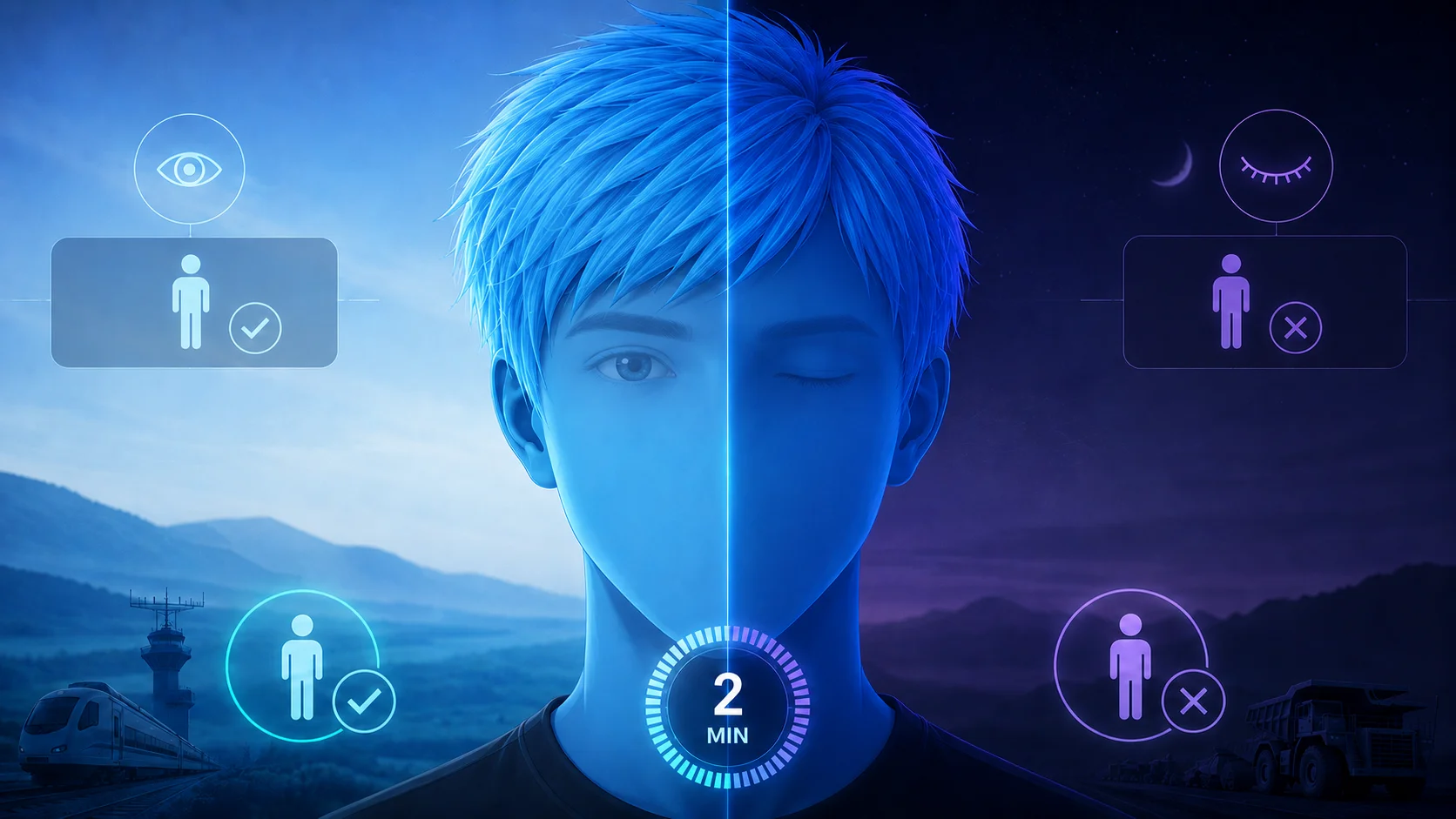
The Eyes Closed–Eyes Open (ECEO) Task is a brief, standardized 120-second EEG recording protocol. Participants alternate between 60 seconds with their eyes closed and 60 seconds with their eyes open while fixating on a central point on the screen.
This simple paradigm requires no complex cognitive effort from the participant. It provides a fast and reliable window into their underlying brain state, making it highly practical for real-world sleepiness detection.
Results
As expected, the KSS scores showed a significant increase in subjective sleepiness after the fatigue-inducing PVT (t(19) = -6.11474, p < 0.00001, Cohen’s d = 1.44). This confirmed that the experimental protocol successfully increased subjective sleepiness. The key question was whether the EEG-based Sleepiness Metric would objectively detect the same shift.
The InnoBrain Sleepiness Metric successfully detected the increase in sleepiness. As expected, the paired analysis was the primary test because each participant was measured before and after the PVT. As a robustness check, we also repeated the comparison using an unpaired test; despite ignoring within-participant dependency, the difference remained significant (p < 0.01, Cohen’s d = 0.87).
Practical Use Cases
A 2‑minute binary alert vs. sleepy rest‑state metric, ideal when continuous recording isn’t possible.
- Shift handover
Before starting a new shift, each operator takes a 2‑minute rest‑state test. If the metric shows sleepiness, the person is not allowed to take over, regardless of how they feel. No continuous monitoring needed during the shift; just a clear go/no‑go at the handover point. - Pre‑trip driver assessment (trucking, bus, taxi)
Test before driving; sleepy → rest. - Post‑lunch / break area screening
In safety‑critical industries, workers can take a 2‑minute test in a quiet break room after lunch. Those flagged as sleepy are given a short nap break or lighter tasks. No need to wear sensors all day, just spot checks at high‑risk times. - Post‑call duty assessment for medical residents
Before a resident returns to patient care after a night shift, a quick test decides if they are fit or need rest. - Consumer self‑check
Smartphone app before driving. - Sleep deprivation
This metric does not measure hours of lost sleep. Instead, it detects the functional consequence of sleep deprivation: whether a person is currently alert or sleepy. After a night shift, poor sleep, or extended wakefulness, a 2‑minute rest‑state test provides a clear, actionable outcome, safe to proceed, or rest required. This binary result removes ambiguity, making it ideal for fitness‑for‑duty checks in safety‑critical settings (e.g., drivers, emergency crews, shift workers). It answers the only question that matters for real‑time decisions: “Is this person too sleepy to perform the task?”
Why This Matters
These results demonstrate that InnoBrain’s Sleepiness Metric can reliably detect sleepiness using only a short, 2-minute EEG recording, without requiring any demanding cognitive task.
This makes it especially valuable for safety-critical environments such as transportation, shift work, heavy machinery operation, and clinical settings, where a quick and objective assessment of sleepiness is essential.