

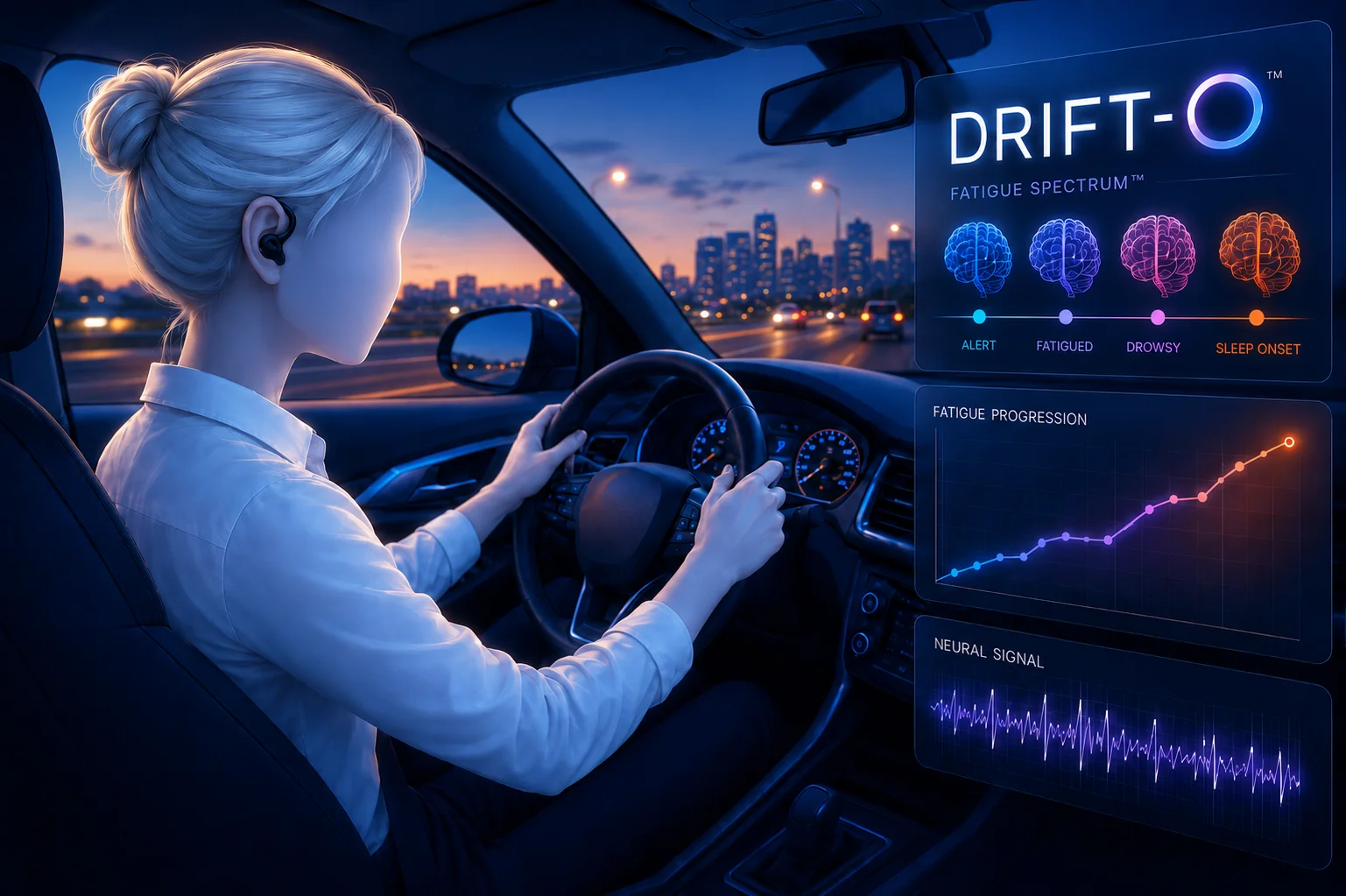
InnoBrain is taking a significant step forward in neurotechnology by moving fatigue spectrum™ monitoring out of the lab and into the real world. While laboratory validations provide a controlled foundation, the true test of any fatigue metric lies in its performance during complex, everyday tasks. Our recent validation study aimed to confirm the subject and task independence of the IB DRIFT-O™ metric in highly realistic simulated driving environments.
InnoBrain DRIFT-O™ metric tracks the brain’s transition across the Fatigue Spectrum™ (Alert, Fatigued, Drowsy, and Sleep Onset). It represents our most advanced generation. Building on our foundational mathematical and hand-engineered models (DRIFT-B™ and DRIFT-R™), DRIFT-O leverages the full EEG montage and adapts to varying hardware.
Building on Robust Lab Validation and Generalization
The success of this real-world driving study reinforces the exceptional performance previously demonstrated by InnoBrain DRIFT-O™ in controlled laboratory environments. To ensure InnoBrain DRIFT-O™ provides a truly subject-independent solution, Leave-One-Subject-Out Cross-Validation (LOSOCV) was employed. This rigorous iterative process involves training the AI model on all participants except one, who is reserved exclusively for testing. This methodology confirms that InnoBrain DRIFT-O™ metrics are not merely memorizing specific data patterns but are robust enough to generalize across new, unseen individuals in real-world applications.
The comprehensive validation across different hardware configurations demonstrates the superior performance of the InnoBrain DRIFT-O™ model:
- Full-Scalp EEG Performance: Achieved an ROC AUC of 0.90, an F1 Score of 0.87, and a Balanced Accuracy of 0.88 (read more here). In practice, this means the system consistently identifies the shift from alert to drowsy without bombarding the operator with false alarms.
- In-Ear EEG Performance: Despite higher noise levels, the model demonstrated exceptional reliability with an ROC AUC of 0.93, an F1 Score of 0.95, and a Balanced Accuracy of 0.94 (read more here). For industry applications, this proves that highly cumbersome, full-head setups are no longer required to achieve clinical-grade fatigue tracking in the field.
Rigorous Methodology in Realistic Settings
To ensure robust results, the study involved 34 participants who each completed three approximately 45-minute driving sessions, yielding 103 distinct driving datasets. EEG data was captured through a streamlined 8-channel setup (Fp1, Fp2, P3, P4, T3, T4, O1, and O2), designed to balance data richness with operational feasibility (Figure 1).
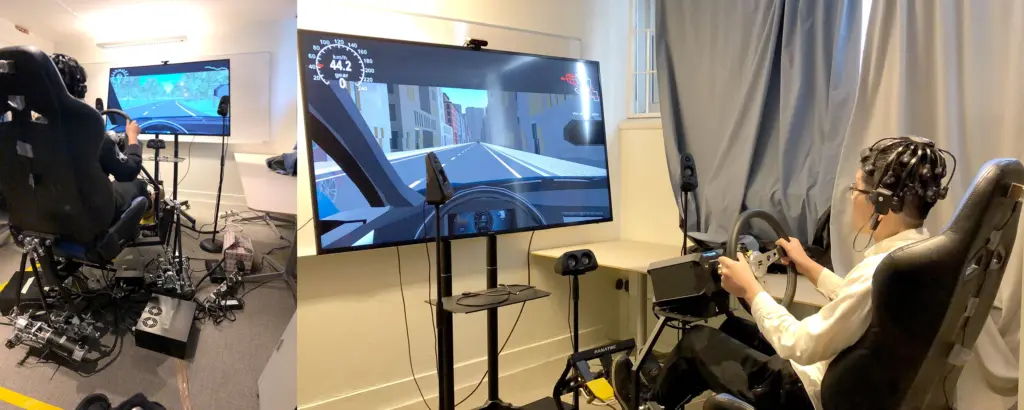 Figure 1: 6-DOF driving simulator equipped with an EEG headset.
To test the metric’s task independence, these 103 sessions were composed of slightly varied driving scenarios, specifically, simulated runs focused on Highway, Country Roads, and City driving, ensuring the metric performed consistently across different real-world cognitive loads (Figure 2).
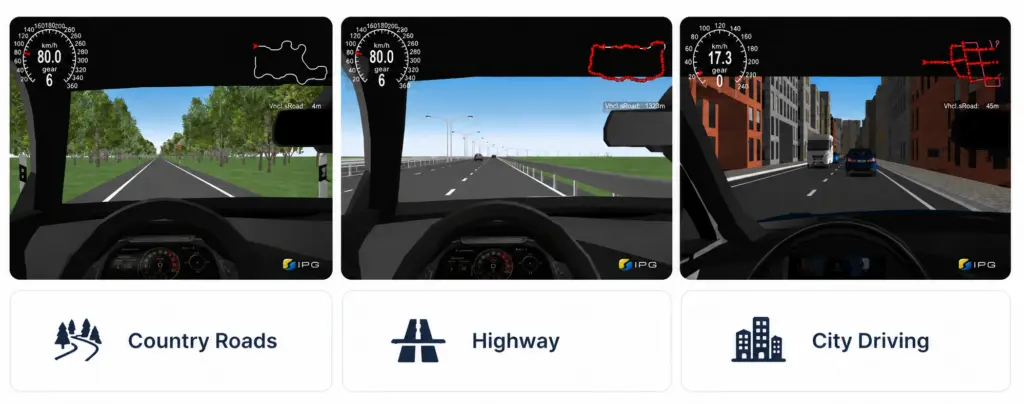
Figure 2: Driving scenarios: Country Roads, Highway, and City driving.
Validating with Subjective Experience
Subjective assessments served as a critical reference for neural data. Using a questionnaire with a scale from 0 to 20, participants were asked to rate their perceived fatigue levels before and after the task. The results confirmed a clear increase in fatigue, with participants reporting significantly higher scores at the end of the sessions compared to the beginning. The difference between the fatigue levels before and after the test is statistically significant (p < 0.05). On average, participants reported a significant increase in fatigue after the test, with the mean score rising from approximately 6.97 to 8.95.
Overcoming Real-World Challenges
Operating in a real-world environment introduced significant complexities, including varying hardware devices, different channel configurations, and higher noise levels compared to a laboratory setting. To address the lack of external labels, a temporal labeling strategy was utilized: the first 10 minutes of each session were categorized as “alert,” while the final 10 minutes were categorized as “drowsy.”
Crucially, these high noise levels were successfully managed using the InnoBrain Cleaning Algorithm learning-based approach. This real-time artifact rejection solution has been validated to ensure cleaner, more reliable data, demonstrating 91% recall and 81% precision (read more here).
The model achieved robust performance in these challenging conditions, demonstrating high reliability across all evaluation metrics. Specifically, InnoBrain DRIFT-O™ achieved an ROC AUC of 0.88, indicating exceptional discriminative power in separating alert states from drowsiness. It maintained detection reliability with an F1 Score of 0.74, balancing precision and recall in environments characterized by high noise and varying hardware. Furthermore, a Balanced Accuracy of 0.76 confirms the model’s ability to provide fair performance across different fatigue levels, even in cases of potential class imbalance. These results validate the model’s effectiveness in real-world driving scenarios where traditional lab-based labels are unavailable.
How Well Does IB DRIFT-O™ Work in Practice?
The analysis of the Fatigue Progression data reveals a clear and consistent upward trend in fatigue scores across all participants as the driving sessions progressed. This validates IB DRIFT-O™’s ability to reliably track neural changes associated with increasing drowsiness in real-world scenarios aligned with subjective score (Figure 3).
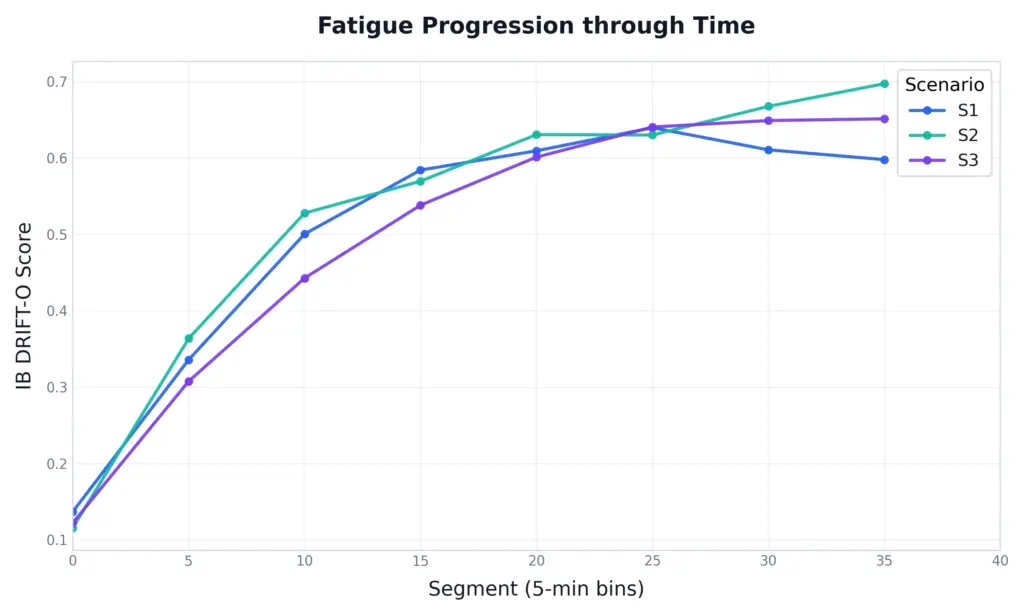 Figure 3: Mean DRIFT-O™ Scores across all participants.
For a closer look, Figure 4 tracks a single, randomly selected participant. This ‘granular’ view shows the system’s sensitivity in real-time: you can clearly see the neural fatigue score fluctuating as the driver navigates different points in their session, eventually plateauing as they become fully drowsy.
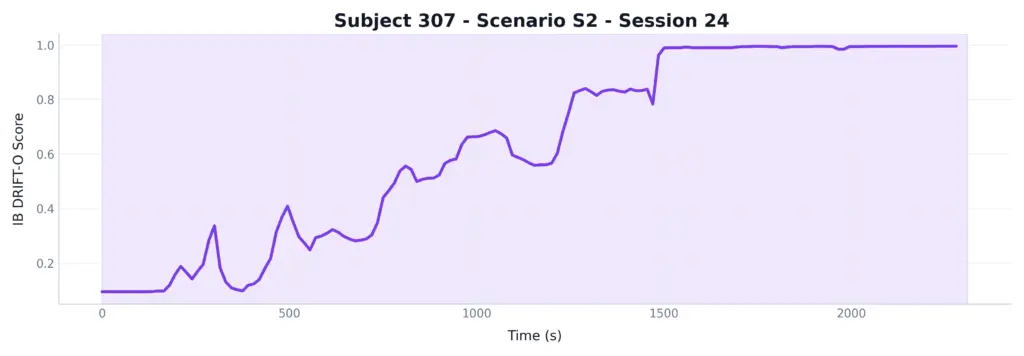 Figure 4: Subject-specific DRIFT-O™ Scores for a random participant.
Ready for Safety-Critical Environments
The success of this validation study underscores that InnoBrain DRIFT-O™ has successfully bridged the gap between controlled laboratory research and complex, operational environments. By demonstrating reliable, subject-independent tracking of cognitive decline under realistic driving conditions, DRIFT-O™ proves it is more than just a theoretical concept. It is a robust, scalable, and real-time solution ready for safety-critical industries, where detecting the subtle onset of cognitive impairment before it compromises performance is paramount.